NFL
                       
Showing posts with label Larry Schmitt. Show all posts

Sunday, 12 June 2016

Five Years of the GUD

by Larry Schmitt


It�s been a while since I�ve written for the blog, and the Gridiron Uniform Database�s fifth anniversary seemed like a good occasion to come back.

I still remember the GUD�s debut on Sunday June 11, 2011 when it was featured on the front page of Uniwatch.


Having been a fan of football history and uniforms since my teens, this was exactly the kind of site I�d hoped would surface one day. I happily clicked away, browsed and explored for hours that Sunday morning, savoring every visual treat.

Of course, much has changed since then.

Originally the site only went back as far as 1933. The years 1920 � 1932 were added incrementally over the summer of 2012, and many of the templates were empty, as photos for that era, especially for the small town teams, are scarce.


According to the sidebar on Bill�s Update page there have been 1,260 updates to the database�s content since a running count was initiated in January 2012. While many were new discoveries, the vast majority represent a collection of adjustments, refinements, tweaks and in some cases, major overhauls that resulted from the relentless and continuous research to provide the most comprehensive and accurate visual library possible.

While there may be times the GUD appears dormant, nothing can be further from the truth.

Most visitors to the GUD are familiar with the names Tim Brulia (historian & researcher), Rob Holecko (webmaster) and Bill Schaefer (graphic artist & researcher), the official owners of the GUD. There also is a network of GUD frequenters who volunteer their time and assist in large-scale projects and/or forward the occasional historical nugget that might lead to a correction.

You can visit the GUD Forum where some of this takes place. The Forum goes all the way back to the GUD�s second day, June 12, 2011. It serves as a quasi-time capsule to many of the early activities, and you can see some of the source material for what is now represented in the database.
My first contribution to the GUD was offering a color photo of the Giants Charlie Conerly in 1948, which led to a correction of New York�s leather helmets for that season.


That turned out to be the first of many for me. I often spend my free hours perusing the internet for pro football history, whether it�s statistics, player biographies or old photos. Whenever I came across something I thought was interesting I�d forward it to Bill and Tim for their consideration. Over time, they tutored me on developing a sharper eye for researching, a major part of which was identifying mis-dated photos (you�d be surprised how many exist in the Getty and AP catalogs), as well as discerning the subtleties of interpreting colors from black-and-white photos.

  
Why does blue sometimes appear darker than red, and other times red appear darker than blue? The best answer I can offer is: it depends on who took the picture, what type of equipment was used, if filters were involved, the type of film and how it was developed.

In March of 2013 I was invited (and possibly may have even been the stimulus for) my first large scale GUD project, which we termed �The Great Belt Overhaul.� What simply began as a casual surfing of old Earl Campbell photos during my lunch hour at work dovetailed into the correction of at least a dozen teams belt colors, most of which spanned the 1960�s through the 1980�s.

At the time the GUD commonly showed teams with black belts as a sort of default. While discovering that the Houston Oilers belts were white with white pants and blue with blue pants, we noticed that the Pittsburgh Steelers varied yellow and black belts for a similar period. While researching the Steelers we found similar evidence for the New Orleans Saints, and while researching the Saints we found that...well, you get the gist of it. One of our inside saying that we still use came from this endeavor...�While looking for one thing, I found something else...�

It was also at this time that most of my efforts were transferred to email, rather than the forum. I do occasionally add to a thread in the General Comments section of the forum, just for the fun of it. It�s been going for about three-and-a-half years now.


Since that time, some of the other large scale projects undertaken have been the addition of the USFL database in November 2013, the addition of officials� uniforms in the May of 2014, 2015�s deep-dive project into newspaper archives that resulted in the GUD having a nearly complete photographic record of preseason games dating back to 1950, and the debut of AFL II earlier this year.

You�ll also notice that the ongoing endeavor to represent every regular and post season game on a weekly basis currently goes back to 1937, save for a small handful of games from the 1940�s where we haven�t discovered a photo yet.


My conservative estimation is that the GUD currently displays 14,320 weekly matchups in full color � where else are you going to find information like that? And you the reader can be confident that what is displayed is accurate, as no stone had been left unturned while researching libraries and newspaper archives. If a photo cannot be found to back it up, then the templates are left blank. Guesstimations are not good enough.

To that end, while most of us conduct our research online through newspaper archives and libraries, Tim has taken several sojourns to the Library of Congress in Washington DC and the Pro Football Hall of Fame in Canton, Ohio.

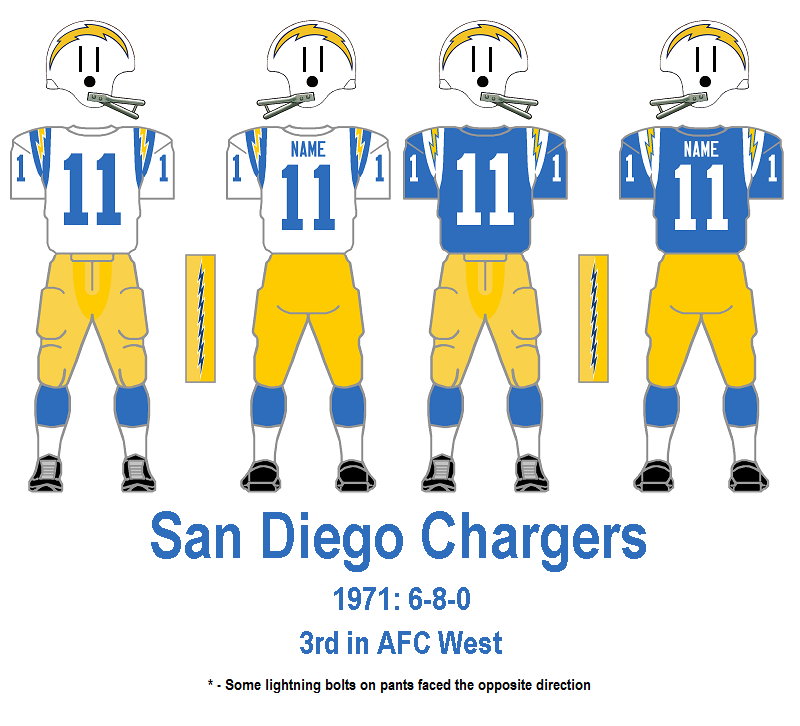
While I most enjoy researching the first three decades of pro football � essentiallythe leather helmet era � I have one modern era project that I remember fondly. One weekend morning in April 2014, while casually looking over photos of the Dan Fouts-era Chargers, I noticed some irregularities in the orientation of San Diego�s lightning bolts on their pants.


I broadened my search to include the 1960�s and found that not only were they facing multiple directions � they could be forward or backward and upward or downward � but over the years the bolts themselves changes shape and size.


I began saving photos in files broken down by era, and while the bolt placements was often erratic, I was able to nail down the style of the bolts definitively. Did you know from 1961-65 the bolts on San Diego�s pants contained eight points on each side, while all other years through 1987 they had seven?


Or that the only year with uniform bolt orientation was 1984?


I�m not sure if Bill recalls this project as fondly as I do. Initially frustrated at the challenging work, he diligently forged a system - over the course of a full year - to accurately present what you see in the San Diego database today. His ultimate balance of persistence and patience paid off in a big way.

Bill himself handled the 1992-present day Chargers bolts research, and along the way picked up on number font variations.


I guarantee you won�t get this attention to detail anywhere else.

So, what�s next? I don�t want to give away too much, but sometime in the near future, the weekly matchups are likely to extend back a few seasons further, and the other AFL�s will ultimately take their rightful place to complete the presentation of every major professional football league over the past 96 years.

There also has been a recent boon in discoveries of missing teams from the 1920�s. Many of the templates that appear blank today will be replaced by full color representations of what these pioneers of the game we all love today wore on the gridiron in near anonymity over 85 years ago

Ongoing corrections and enhancements are always taking place. Recently, many teams have had their catalogues refined with what we call the two-tone effect on their pants (the result of two differing materials, usually with the front being a shiny, satin-like quality). 


There also has been a recent emphasis on fine-tuning jersey number fonts and sizes as well as leather helmet styles. Some of these differences can be seen in places like the weekly matchups as gifs when multiple styles were worn concurrently.


The research section also is updated regularly. Among the information readily available is a log of every instance of and NFL team wearing white at home since 1957 and what is believed to be the most comprehensive representation of helmet decals anywhere.


Rest assured, all of these will be updated continually as the 2016 NFL season proceeds.

Earlier this year, Rob gave the GUD itself a face lift. The front page has been reorganized to better display the content that is available. Several of the pages inside are now sortable, making navigation easier.


He also added some new features that highlight historical facts and firsts.


All that great information aside, what I appreciate most about the GUD is that it is a community. Right from the very beginning Tim, Rob and Bill welcomed all visitors not only to enjoy the content that was presented, but take part in the collaborative journey that is the GUD. They allowed an obsessive fan like myself to feel like a part of the group.

I'm looking forward to the next five years and all the discoveries that await us!

Thursday, 7 March 2013

Cris Carter - HOF Profile

If there is one word to describe the 16-year career of wide receiver Cris Carter, it would be consistency.

In an era where passing and receiving records fall regularly, it is sometimes easy to fail to appreciate the careers of those who came before. Consider these facts when pondering the accumulated totals from Carter's career, where he ranked second all time in career receptions with 1,101 and touchdowns with 130 at the time of his retirement following the 2002 season.
  • His 130 touchdowns came from the arm of 13 different passers.
  • Of his 12 seasons in Minnesota, the Vikings qualified for the post season eight times with seven different starting quarterbacks - making it twice with Warren Moon in 1994 and 1996.
  • He was the first player to have two seasons with more than 120 receptions (with only Wes Welker equaling that to date.) 
  • Carter's 10 post season games with Minnesota saw him amass 60 catches for 837 yards and eight touchdowns.  
  • The Vikings won-loss record was 76-29 when Carter scored at least one touchdown.
    • Carter had 29 multiple-touchdown games, including three with 3 scores.
  • He holds 19 Vikings individual receiving records.
Of course, none of this seemed possible when Carter was released by  Philadelphia just prior to the start of the 1990 regular season. His three years with the Eagles were tumultuous. Substance abuse issues and off field problems forced management to waive his contract as he had become an unreliable performer and distraction to the team. 
    Carter played mostly a back up role in his first season with Minnesota and focused on cleaning up his personal life. After the 1991 season a regime change brought in a new head coach, and a newly focused Carter began to emerge a primary weapon for Minnesota's offense.

    The Viking's quarterback situation was unsettled, neither Rich Gannon nor Sean Salisbury emerged as the full-time starter. Despite the uncertainty, and three games missed with a broken collar bone, Carter lead the team in receptions, yards and touchdowns. Missed starts were rare for Carter, who played a full 16-game schedule in 13 of his 16 seasons, totaling 234 games played. The Vikings began a run under coach Dennis Green where they would qualify for the post season in eight of nine seasons.

    A change in quarterback in 1993 from Gannon to Jim McMahon brought Carter's first of eight consecutive 1,000 yard seasons, Pro Bowl invitations, and another playoff berth. But the greatest success was just around the corner.

    Moon arrived via a trade with the Houston Oilers, settling Minnesota's revolving door at quarterback (for two-and-a-half seasons anyway.)  With stability in the offense, Carter was able to establish a rapport with the Vikings passer and strung together three great seasons and for the first time saw his name appear in the NFL record books.

    Carter established the NFL record for receptions in a season with 122 in 1994. His 1,256 yards and seven touchdowns as Minnesota's primary receiving threat saw him named First Team All Pro as the Vikings won the NFC Central, but for the third straight year went one-and-done in the playoffs.

    1995 was an even better year for Carter personally, even though Minnesota as a team slumped to 8-8, He matched the remarkable 122 catch effort from the year before, but augmented it with 1.371 yards and an NFL leading 17 touchdowns - including four 12-reception games. Amazingly, he was only named Second Team All Pro, as he tied for second in the league for catches that year. Jerry Rice also had 122 receptions while Herman Moore set the new mark at 123.

    A mid-season collar bone injury to Moon brought another quarterback change for the Vikings, but Carter continued his reliable production. With Brad Johnson taking over Carter finished the season with 96 catches, 1,163 yards and 10 touchdowns. His three year total for 1994-1996 still ranks among the most prolific of all time: 48 games played, 340 catches, 3,790 yards and 34 touchdowns.

    Carter lead the NFL with touchdown catches again in 1997 with 13, despite Johnson being unable to complete the season with an injury. Randall Cunningham took over in December and the Vikings won their first playoff game under Green in the Wild Card round.

    In 1998 a renewed Cunningham commanded the NFL's highest scoring offense in history, and Carter was a major part of their success. Minnesota's 556 points scored (averaging 34.8 points per game) broke the record of 541 held by the 1983 Washington Redskins. Although rookie receiver Randy Moss broke onto the scene and stole most of the headlines, Carter had another 1,000 yard season on 78 catches and 12 touchdowns. The 15-1 Vikings advanced to the NFC Championship Game, but lost in overtime to the Atlanta Falcons.

    The following season may have been Carter's best season of all. His 90 catches for 1,241 yards and league leading 13 touchdowns (his fifth consecutive season with at least 10 scoring receptions) were punctuated by a 13.8 yard-per-catch average, his highest of any season where he caught more than 40 passes. He was rewarded with a spot on the First Team All Pro list. Most significantly, Carter was awarded the NFL's Walter Payton Man of the Year Award, which is an honor give in recognition of a player's volunteer and charitable efforts, showing how far he had come since his early days in Philadelphia.

    Following two more productive years in Minnesota, which included becoming just the second player to reach the 1,000 catch plateau in 2000, Carter temporarily retired. He was lured out midway through in the 2002 season by the injury depleted Miami Dolphins who were engaged in a three team race for first place in the AFC East. Carter retired for good after the season.

    The six-time finalist joins 11 other Vikings in Canton, continuing a run of recognition for Minnesota as Carter is the fifth member of the franchise to receive enshrinement in the past six classes (Chris Doleman 2012, John Randle, 2010, Randall McDaniel 2009, Gary Zimmerman 2008.) Carter played in 188 games (with 177 starts) and had 40 of his 42 career 100-yard games with the Vikings, and is one of only six players to have their number retired by the club. He is also a member of the NFL's All Decade Team for the 1990's.

    Cris Carter's Career Statistics at Pro-Football-Reference.com

    Cris Carter's career uniforms:


    Thursday, 29 November 2012

    A Head-to-Head History: The Atlanta Falcons and the New Orleans Saints


     The Falcons and Saints joined the NFL a year apart during the transitional, pre-merger phase of the league. Prior to Atlanta joining in 1966 and New Orleans in 1967, the southernmost team on the coast had been in Washington DC. They became natural rivals, as bus loads of fans venture on seven-hour road trip between the cities when they play one another. A further non-geographic bond is the fact that the franchises share the same all-time leading scorer - Morten Andersen (New Orleans 1982 - 1994, 1,318 points; Atlanta 1995 - 2000, 2006 - 2007; 806 points.)

    Although they currently reside in the NFC South Division, the Dixie Rivalry began in the post-merger NFL's NFC West in 1970. They usually battled with one another to stay out of the division's basement, as the Rams and 49'ers more often that not finished at the top. Prior to 1970 the Falcons resided in the NFL Coastal Division while the Saints rotated between the Capital and Century Divisions.

    Like most expansion teams, the Falcons and Saints struggled on the field with roster mostly stocked with young players and veteran cast-offs, as there were no quick fixes available via free agency. The first meeting between the teams took place in Week 11 of the 1967 season, where the 1-8-1 Falcons visited the 1-9 Saints in Tulane Stadium. Billy Kilmer lead New Orleans on a touchdown drive in the fourth quarter for a 24-20 win. Two minute drives and comeback victories would become a recurring theme over the years.

    That was not the case in 1973 though. In the midst of a nine-game win streak against their Southern rivals, the Falcons set a team record for points in a remarkable one-sided rout. After the end of a 0-0 first quarter, Atlanta went on a scoring rampage that saw them rack up 62 points. The Falcon offense was unstoppable, moving the chains with 32 first downs on the strength of 218 rushing yards, while the Saints offense was error prone, turning the ball over eight times, including five interceptions by Archie Manning.

    The balance of the 70's saw the rivalry achieve competitive balance, with many of the signature moments occurring in New Orleans Super Dome. In 1978 Atlanta became the first of the two teams to qualify for the post season, and a signature win over the Saints in November helped them get there. The 5-5 Saints carried a 17-6 late into the fourth quarter against the 6-4 Falcons. Atlanta quarterback Steve Bartkowski lead the Falcons on a touchdown drive that closed the gap to 17-13 with 0:57 on the clock. After recovering the attempted on-sides kick, New Orleans attempted to run out the clock. Coach Dick Nolan elected to run a play on fourth-and-two, but halfback Chuck Muncie was stopped short of the line to gain and the Atlanta offense came back onto the field with 19 seconds left. Bartkowski lined up under center with three receivers split out wide to the right of the formation. The Saints were deployed in a prevent package featuring seven defensive backs. Bartkowski heaved a desperation pass toward the end zone, where his receivers attempted to get under the pass in heavy traffic. At least a dozen hands from both teams reached up to either grab or bat the ball down, but Falcon receiver Alfred Jenkins came away with possession off a tip, avoided several defenders and crossed the goal line for the decisive and dramatic 57-yard score. The "Big Ben" play lead highlight programs across the country and the momentum seizing win not only propelled Atlanta on a playoff run, they produced a win over the Philadelphia Eagles in the Wild Card round before losing to the eventual NFC Champion Dallas Cowboys in the Divisional playoffs.

    The schedule makers didn't do the New Orleans faithful any favors by schedule a visit from Atlanta on opening day the following season. The back-and-forth shootout saw the teams combine for over 1,000 yards of offense, with stars from both teams rack up impressive offensive numbers: Muncie and Atlanta rookie William Andrews each eclipsed 160 rushing yards, Jenkins had seven catches and a touchdown for the Falcons, while Wes Chandler produced 205 yards on just six catches, including a 40-yard score on an option pass from Muncie. Late in the game, then into overtime, New Orleans rookie kicker/punter Russel Erxleben experienced the highs and lows of his dual profession. Manning lead the Saints on a late drive that was capped with Erxleben's 38-yard field goal knotting the score at 34-34 with 44 seconds remaining. Midway through the extra period, Erxleben had the ball snapped over his head in the punt formation from the New Orleans 32 yard line. He scooped it up near his own goal line, then hurried a two-handed pass under pressure into the hands of Falcon James Mayberry who scored from six yards out for the stunning 40-34 win. Atlanta finished the 1979 season a disappointing 6-10, while the Saints recovered somewhat, finishing a then franchise best 8-8.

    1991 saw a reversal of fortunes in the NFC West. the Saints finished in first place at 11-5 and the Falcons qualified as a Wild Card at 10-6, marking the first time either the 49'ers or Rams were left out of the post season since 1982. Three second half lead changes were capped by Michael Haynes 61-yard touchdown pass from Chris Miller with 2:41 remaining. New Orleans took possession on their own 17, and advanced to Atlanta's 35 with 1:10 to play. Bobby Hebert's pass was intercepted by Tim McKyer, who lateraled the ball to Deion Sanders, who ran around before lateraling to Joe Fishback who finished the play with an apparent touchdown. Following instant replay, it was determined Sander's exchange with Fishback was a forward pass, disqualifying the touchdown but the Falcons retained possession and ran the clock out. The loss was especially tough for New Orleans to take. Having made the post season three of the previous four seasons, each had ended with a one-game exit without a victory. The Falcons lost the following week to the eventual Super Bowl champion Washington Redskins.

    Morten Andersen made one of his final game winning kicks for the Saints against his future team in 1994. The offensive game was remarkable in the fact that New Orleans was able to pull off the victory despite turning the ball over five times. the Falcons were unable to capitalize, despite churning out almost 400 yards of offense, they settled for six Norm Johnson field goals. The kicking duel was settled in the final two minutes of the game. Johnson booted a 30-yard field goal to put Atlanta ahead 32-30 with 1:44 remaining, but Andersen's fifth field goal of the day came from 39-yards out and just 0:08 left on the clock decided the outcome, 33-32.

    New Orleans probably regretted letting Andersen leave via free agency following the 1994 season, as he signed with the Atlanta and was directly responsible for a Falcon sweep of the Saints in 1995. During his return to the Super Dome in September, Andersen booted four field goals, including a 21-yarder in overtime for the 24-21 Falcon win. In the December meeting at Georgia Dome, Andersen again was the deciding factor for the Falcons offense, but this time from long range. He set an NFL record with three successful attempts from 50 yards out - 51 and 55 twice - as Atlanta won 19-14.

    The most poignant meeting, though albeit not the greatest game, was the Saints return to the Super Dome on September 25, 2006. After spending the 2005 season playing their "home" games at the Alamodome in San Antonio, TX and Tiger Stadium in Baton Rouge, LA in the aftermath of Hurricane Katrina, the Saints returned home with a new head coach and quarterback and a 2-0 record. Atlanta was also 2-0, but were unable to match the intensity of the Saints or their fans in the raucous dome. After surrendering a touchdown on a blocked punt, the Falcons managed an Andersen field goal and nothing more. The inspired New Orleans defense dominated, yielding just 10 first downs to Atlanta while holding Michael Vick to 12-31 passing for just 137 yards. Drew Brees' debut in New Orleans was modest statistically, but he was efficient and the Saints went on to a 23-3 win, a 10-6 record and NFC South Title and a trip tot eh NFC Championship game, where they ultimately lost to the Chicago Bears. changes would soon be in store for the Falcons as well, but the groundwork had been prepared for the Saints and Falcons to finally emerge as contenders at the same time.

    The meeting at the Super Dome in Week 3 was a key meeting between the two rivals. The 1-1 Saints were defending Super Bowl Champions while the Falcons were coming off the first back-to-back winning seasons in franchise history. The game featured four lead changes as quarterbacks Brees and Matt Ryan moved their respective offenses up and down the field. Lance Moore's 16-yard touchdown reception at the end of the third quarter gave the Saints a 21-17 lead. Ryan responded by leading Atlanta on a 10-play drive that was capped by a 22-yard touchdown pass to Roddy White to regain the lead 24-21. Following an exchange of punts, Brees guided New Orleans to a tying field goal with nine seconds remaining, sending the game into overtime. The Falcons received the kickoff and punted after three plays. Four Brees completions moved New Orleans from their own 32 to the Atlanta 11. Seemingly in safe position, the Saints elected for a 29-yard field goal attempt on first down, but Garret Hartley pulled the ball wide left despite kicking from the right hash mark. Ryan and the Falcons capitalized, methodically advancing the ball from their own 20 to the Saints 23 in 12 plays. Matt Bryant's 46-yard attempt was good for the 27-24 win. Atlanta finished atop the NFC South with a 13-3 record with New Orleans second at 11-5, however both teams lost their first post season contests.

    Tonight the Falcons off look to get revenge on the Saints who handed them their first lost three weeks ago, while the Saints try to stay in the playoff hunt after a 0-4 start.

    Sunday, 25 November 2012

    A Head-to-Head History: The Chicago Bears and the Minnesota Vikings


    The Minnesota Vikings joined the NFL's Western Division as an expansion team in 1961 and wasted no time making their mark with a surprising upset in their very first game, a 37-13 whipping of their new Western Division rival Chicago Bears in Metropolitan Stadium. Possibly even more unique than their rookie scrambling quarterback Fran Tarkenton was the fact that the Viking's uniforms featured purple as their primary color, the last team to do so was the 1933 Portsmouth Spartans. Tarkenton had a magnificent afternoon in his debut, throwing for 250 yards and four touchdowns against George Halas' normally stout defensive unit that featured future Hall of Fame members Bill George and Doug Atkins. 


    Normalcy returned in their second match-up that year as the established team Chicago rolled to a 52-35 win at Wrigley Field. That win set off a period of domination where the Bears record against the Vikings would be 11-2-2, which included and NFL Championship for the Bears in 1963.
    Butkus and the Bears captured the 1963 NFL Title, while Marshall and the Vikings
    got theirs in 1969, before losing to the Chiefs in Super Bowl IV.
    Payton carries against
    Minnesota in 1983
    In 1984 the Bears emerged as the divisions dominant team and had one of the great season in NFL history in 1985 when the 15-1 Bears ran roughshod over the NFL on their way to a dominant victory in Super Bowl XX. By the time Chicago came to visit Minnesota in Week 7 of the 1986 season, the Bears had won 12 consecutive games, which included six-in-a-row against their divisional foes. The most recent came just two weeks earlier in Soldier Field where the Bears bullied Minnesota quarterback Tommy Kramer with seven sacks in a miserable 11-for-30 performance in a 23-0 rout. Things were quite the opposite in the Metrodome however. Kramer was six for six for 134 yards and two touchdowns in the first quarter, giving Minnesota an early lead and allowing his defense to return the favor on Bears signal caller Steve Fuller with seven sacks of their own. The Vikings out-gained Chicago 263-56 in total yards in the first half as they built a 16-0 lead. The final tally ended 23-7 as the stout Minnesota defense limited Payton to 28 yards on nice carries. The Vikings finished in second place in the division with a 9-7 record but did not qualify for the playoffs. Chicago went on to a 14-2 record but were upset at home in the Divisional Round by the Washington Redskins.
    Harbaugh and Ditka get into it in 1992
    The division rivals met in Week 14 of the 1994 season with the NFC Central title on the line. The 8-4 Bears and 7-5 Vikings exchanged the lead four times through the first three quarters as the Bears lead 24-16. Warren Moon lead Minnesota on scoring drives for a field goal, then a touchdown capped with a two-point conversion to retake the lead for Minnesota 27-24 with 4:12 remaining. Steve Walsh then lead the Bears on a drive that tied the game with a 33-yard Kevin Butler field goal at 1:55 tying the score 27-27. Butler had a chance to win the game with a 40-yard attempt in overtime but the ball sailed wide left. From their own 35, Moon lofted a pass to Chris Carter at mid-field, who had made a double-move, and outraced the Bears secondary the final 50 yards for the deciding 65-yard touchdown for a stunning 33-27 win.  Minnesota went on to win the division at 10-6 and the Chicago finished second at 9-7. The two met again at the Metrodome in the Wild Card round of the playoffs. Chicago took the rematch with an opportunistic defense, intercepting Moon twice and recovering two fumbles, while limiting the Vikings to only 49 yards on the ground in a 35-18 win. The Bears would lost to the eventual Super Bowl Champion San Francisco 49ers the following week. 
    Although most Vikings-Bears meetings were fairly typical uniform-wise, in 2007 in the Metrodome, the Vikings went mono-purple, while the following year they
    went retro and the Bears went mono-white...
    ...and in the second game in 2008 in Chicago, the Bears broke out the Orange Alts...
    ...and two years later in November 2010, the Bears went retro themselves,
    while the Vikings donned purple pants
    The Vikings won the next two meetings in Minnesota, while the Bears then won the following two meetings in Chicago.  The second meeting, in late 2010, after a winter storm collapsed the Metrodome roof, was played in frigid temperatures at University of Minnesota's TCF Bank stadium.  It would be memorable for being the final appearance of Brett Favre's career, and the Vikings would lose 40-14.
    The arrival of head coach Bud Grant from the CFL and the Purple People Eaters front four featuring Alan Page, Carl Eller, Jim Marshall and Gary Larsen turned the tide of the series. From 1969 through 1983 the Vikings record against Chicago was 22-6. This period included 10 Division Titles and many epic playoff contests with the Dallas Cowboys and Los Angeles Rams. Unfortunately, all four Super Bowl appearances for the Vikings ended with disappointing losses.


    In the midst of this Minnesota NFC Central domination, came a record setting performance from a remarkable player. In  Week 10 of the 1977 season the 6-3 Vikings visited the 4-5 bears. Halfback Walter Payton was ill with the flu, but coach Jack Pardee knew his star back was Chicago's only chance against Minnesota's strong defensive front.  Chicago's first play on the cold, damp, windy afternoon at Soldier Field was an end run where Payton charged ahead for 29 yards. The all rush drive ended in Minnesota territory on a failed fake field goal attempt, but Payton would fin the end zone in the second quarter on a one yard plunge, and a Bob Thomas field goal gave the Bears a 10-0 halftime lead. The weather conditions were so foul that Bears quarterback Bob Avellini attempted just one pass in the half, a six-yard completion to Payton, who had 26 carries for 144 yards - an impressive total for a full game! The first Bears possession of the third quarter resulted in a punt being blocked for a Viking touchdown, cutting the lead to 10-7. Both defenses clamped down and yards were at a premium. When the Bears received the ball at their own 20 yard line with 5:38 Payton had 201 yards on 36 carries. After picking up a first down, Payton gained 58 yards on his 38th carry, being tackled at the Vikings nine-yard line. Two rushes and a sack gave Chicago a fourth-and-goal and coach Pardee did not have confidence in a field goal attempt, even from short range. Payton rushed for six and was tackled at the two, giving him 275 yards, breaking O.J. Simpson's record of 273. The Bears defense held on for the victory, evening Chicago's record at 5-5. Both teams finished the season at 9-5. The Bears qualified for the post season for the first time since 1963 but lost to Dallas in the Wild Card Round. Minnesota won the Central Division, defeated the Rams in the Divisional round but lost to the Cowboys in the NFC Championship Game.


    One of the series most unforgettable moments occurred in the fourth quarter of a game at the Metrodome in October 1992 with Chicago nursing what seemed like a comfortable 20-0 lead. Bears quarterback Jim Harbaugh had played well, leading four scoring drives, throwing for a touchdown and running for another. On a first down he called an audible, but telegraphed a pass that was intercepted and returned for a touchdown. Coach Mike Ditka was apoplectic, and met Harbaugh on the field, screaming, cursing and gesturing wildly. After the game, Ditka did not back down, and told the press, "I'll just say this...if it happens again, there will be changes made and they will be definite and they will be permanent. I'm not going to put 47 players' futures in the hands of one player who thinks he knows more than I do." The sudden change in momentum was palpable. The Chicago offense stagnated, gaining only two first down the rest of the way, while the Minnesota offense capitalized. Quarterback Rich Gannon was a perfect 7-7 in leading two touchdown drives to complete the improbable comeback. This was the beginning of the end for Coach Ditka in Chicago. The Bears struggled to a 5-11 record, their worst in a decade. The Vikings won the NFC Central title with an 11-5 mark but exited the playoffs in the Wild Card round with a loss at home to the Washington Redskins.